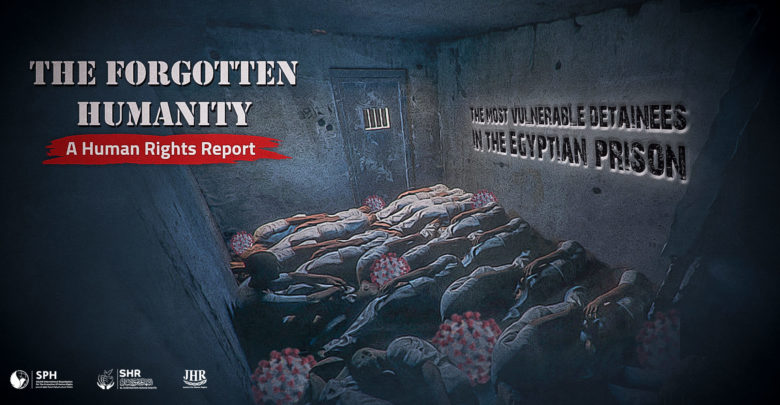
The Forgotten Humanity….
report | Human rights report on the situation of the most vulnerable detainees in the Egyptian prisons
also available in: العربية
Salam International Organization for the Protection of Human Rights - SPH, in partnership with Justice for Human Rights Foundation and El-Shehab Center for Human Rights, issued a report in the form of human rights research on the situation of the most vulnerable groups in Egyptian prisons.
It deals with human rights research, reconciling
This report was based on reconciling the Egyptian and international legislative norms, which may allow the Egyptian authorities to release prisoners due to the spread of diseases or the deterioration of health conditions, and the extent of their compatibility with the most vulnerable prisoners inside the Egyptian prisons, and to examine their eligibility for multiple calls for their release, in light of the spread of (Coronavirus - COVID-19).
The report also relied on various examples of these prisoners, as a model for hundreds -even thousands- of cases inside the Egyptian prisons, in order to shed light on that segment, and what harm the spread of the virus may cause them. The report considered that the segment of the most vulnerable detainees are mostly: (women, children, the elderly, and those patients with chronic or dangerous diseases), while studying the effects of poor medical care and health services in prisons.
And human rights research came in the year 2020, the world was invaded by the “emerging Coronavirus - COVID 19“, which was classified by the World Health Organization as a “global pandemic”, and at the time of writing, more than two million people have been infected, in different countries, and nearly one hundred and fifty thousand people around the world, prompting many countries to take all strict precautionary measures that help to limit the spread of it.
The countries worked on stopping all educational, sports, artistic, religious and social activities, the gatherings of which pose a danger of the virus spreading among wider segments of society.
In this context of precautionary measures, many countries have not forgotten the gatherings inside prisons and places of detention, because of the danger they pose to prisoners or others, including members of the police and administrative bodies, so many steps have been taken to deal with these potential centers of infection, within the framework of domestic and international law. Moreover, they released a number of prisoners to prevent the spread of the disease, to avoid a catastrophe inside prisons.
However, many other states did not consider taking the same measures, such as the releasing decisions, and Egypt was among these countries that did not respond to several human rights calls and initiatives launched by NGOs, in order to release the prisoners, in light of the overcrowding inside the Egyptian prisons, poor medical care, and the unhealthy environment inside these places. Moreover, Egypt issued decisions to prevent visits to all the Egyptian prisons, which is insufficient and not really a solution to address the crisis of the Coronavirus spread within prisons and places of detention, as they aren’t prepared to deal with such situation.
The purpose of all appeals to the Egyptian government was to play the role of civil society using its efforts towards helping governments in times of calamities and epidemics. It is a humanitarian intervention, not political, nor evaluative of the government’s performance. All the advanced countries in the medical field bowed to this pandemic, and therefore there is no room to assess the weakness of the Egyptian government in the medical treatments with it, even if the observations focus on the reality of government dealing with this pandemic and the decisions and policies taken to limit the spread of it.
Hence, working to prevent any human assemblies any where has become an urgent demand, not a social welfare that the Egyptian government can accept or reject.
There are groups inside these places are easy for the Egyptian government to deal with and release, in order to avoid the overcrowded gatherings, which may pose a danger, not only in prisons but also the whole country, if only one of them were infected.
Egyptian places of detention have witnessed deaths resulting from the failure to provide medical services and health care to prisoners and detainees intentionally, which we considers as a medical negligence. Prisoners and detainees - especially the sick and the elderly - have rights to be provided by the authorities in control of places of detention regarding medical and health care according to the law and the Egyptian Prison Regulations, and these rights are stipulated in the Standard Minimum Rules for the Treatment of Prisoners, recommended by the United Nations and approved by the Economic and Social Council under the title (medical services).
From this standpoint, this report refers - from a humanitarian angle - to a group of detainees inside prisons and detention facilities, who constitute (the most vulnerable groups), because they are in a dire need of special treatment, in the continuation of this virus’s spread and the lives wasted due to it, without the presence of medical treatment mechanisms that can stop it, too.
An overview of the health conditions in the Egyptian prisons:
Certainly the prisons in general -and the Egyptian prisons in particular- are not places of entertainment, but -as is known to all followers from civil society organizations- the situation inside any prison or place of detention should not reach the dire situation in any way, affirmed by the jus cogens in the prison administration affairs. There are many diseases in the prisons in Egypt, including tuberculosis, diabetes, heart diseases, bronchial Asthma, fever, rheumatism, skin diseases, and cancer.
In the framework of the follow-up, and the 68 prisons owned by the Egyptian government, in addition to 382 lockups inside the police stations, it is very clear that they are full of poor conditions, according to the huge number of complaints reflecting the poor medical care services and the unhealthy environment inside them.
Overcrowding…
Logically, the Egyptian government does not want to have gatherings that pose a danger of such numbers inside prisons, and by issuing its decision to prevent visits from prisoners, it intended to take precautionary measures to limit the spread of the pandemic virus, but the high numbers of people in these places constitute a major obstacle that may not prevent the spread of the virus , especially since there are isolated places -such as the French and American aircraft carrier- where hundreds of military personnel have been infected, although they have not been in contact with anyone for several months. Until now, it’s not known how this virus began, and it is possible that some people are carriers of the virus without knowing.
Thus, the overcrowding that exceeds the capacity of prisons and detention facilities remains the most troublesome issue in this regard.
According to the report of the National Council for Human Rights[1], which was published in 2016, the percentage of overcrowding in the Egyptian prisons only -without other places of detention such as police stations and military areas- exceeded 150%, and, according to the report, reached 300% in police stations.
In its annual report for the year 2015/2016, the council stated that the reports of the council delegations that visited prisons unanimously agreed on the poor conditions available in prisons due to the overcrowding and severe need to services.
The World Health Organization has warned that the high number of prisoners inside prisons and detention facilities may cause hotspots for the spread of the Coronavirus in many countries[2], and stressed the need for countries to take the necessary and appropriate measures in this regard.
The United Nations High Commissioner for Human Rights, in a statement[3], expressed her deep concern at the overcrowding in prisons, which contains unclean and unsanitary conditions, and may be a cause of a wider spread of the emerging coronavirus, and the statement mentioned, said by Mrs. “Michelle Bachelet”, Coronavirus is starting to overrun the prisons, and the conditions of political detainees and prisoners of conscience must be considered, calling on governments to release all those who were not detained on legal grounds, including political detainees and prisoners of conscience.
Weak medical services and the unhealthy environment…
In addition to the aforementioned accumulation factor, the factor of poor medical services, was mentioned in a field research[4] on health in Egypt’s prisons, dealing with the determinants of health within the closed prison world, issued by the “Egyptian Initiative for Personal Rights“, stating that the reality in the exercise of the right to health within the Egyptian prisons upon application, passes through several stations, and in each station there are obstacles that prevent the move to the next station, due to the delay in health care, which leads in quite a few cases to death.
The research concluded that the living and
health conditions inside prisons -based on the testimonies of former
prisoners- are not consistent with the minimum components of the right to
health, in terms of the availability and quality of health services and the
efficiency of those providing them. The quality of health service varied
between prisons in Egypt at the level of Infrastructure and equipment, and at
the level of assigned doctors’ clinics varied. Furthermore, there was often a
shortage in providing urgent services in emergency health cases, due to the
slow procedures or because that the final decision is in the hands of the
prison administration only. For women and children, levels and forms of care
provided to them varied, but they are alike in being inadequate and sometimes
inappropriate. In terms of health components – also the preventive health
measures - which include food and sanitation (toilets), hygiene, lighting,
ventilation, and exercise, they lacked the necessary attention from the prison
administration, as the absence of hygiene and maintenance of the cells, and
toilets, and the severe crowding of prisoners had a negative role in affecting
their health.
[1] http://www.nchregypt.org/media/ftp/Executive%20summary%202015-2016.pdf
[3] https://news.un.org/en/story/2020/03/1060252
[4] https://eipr.org/sites/default/files/reports/pdf/health_in_prison_e.pdf
Click to Get File.